
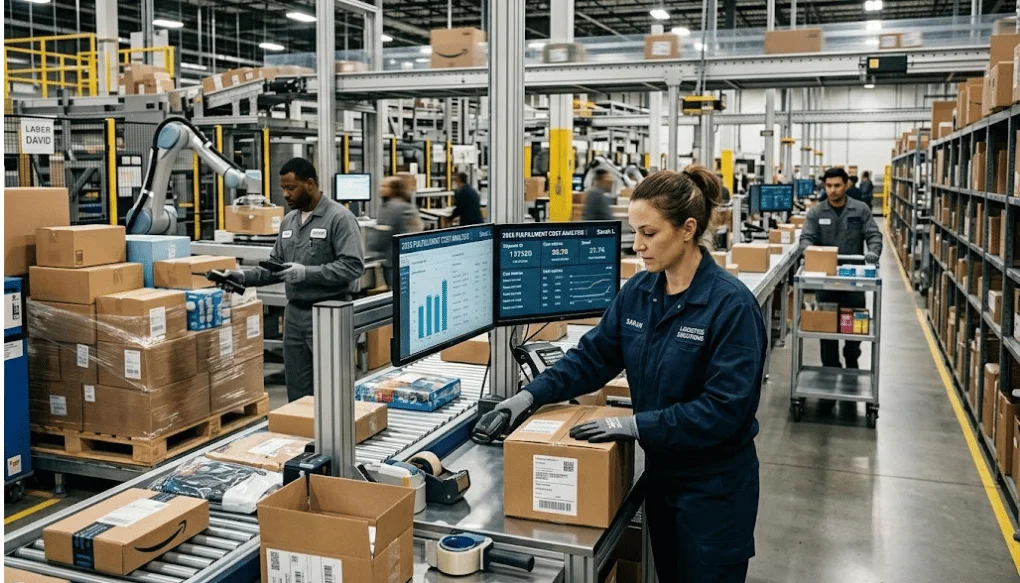
Ask most store owners what an order costs to ship, and you get one number: postage. That number is wrong by half. The same order also carries a pick fee, a pack fee, storage rent, packaging materials and, roughly one time in five, a return. Stack those together, and a simple US parcel runs $9 to $16 in 2026.
Margin leaks there quietly, because no single line looks big enough to argue with. Pricing e-commerce fulfillment honestly starts with seeing the whole stack at once.
The short answer: e-commerce fulfillment covers everything between the click and the doorstep. That means receiving stock, storing it, picking, packing, handing the parcel to a carrier, and processing returns. A US store pays roughly $9 to $16 per order all in during 2026, and the model you choose moves that number more than any single fee.
The four e-commerce fulfillment models, compared
Four models cover almost every store. They differ less on headline price than on where the price hides, and on how quickly each one runs out of road.
| Model | Cost per order (US, 2026) | Control | Time to set up | Where it stops making sense |
|---|---|---|---|---|
| Self-fulfillment (in-house) | $6 to $11 in postage and materials, plus your own unpaid hours | Total | A weekend | Past about 300 to 500 orders a month, when packing eats the week |
| Third-party logistics (3PL) | $2.75 first pick and $0.50 per extra item, plus $5.50 to $11 carrier, plus storage | High on brand, none on the warehouse floor | 6 to 10 weeks | Below roughly 300 orders a month, where monthly minimums near $517 swamp the savings |
| Dropshipping | No stock cost, but net margins cap out near 10% to 20% | Almost none | Days | The moment you need fast delivery, branded boxes or reliable stock data |
| Marketplace-managed (Amazon FBA, Walmart WFS) | $3.30 to $5.00 per unit handling, plus 12% to 18% referral | Low; the platform sets the rules | 2 to 4 weeks | When you want the customer relationship, or sell mostly off-platform |
TL;DR
- Budget $9 to $16 per order all in for 2026, not just postage.
- Pick and pack is the smallest line on the bill. Carrier charges are the biggest.
- A 3PL usually pays off between 300 and 500 orders a month, sooner if your own time is worth anything.
- Returns cost about $10 to $20 each to process, and one US online order in five comes back.
- Marketplace programs are cheap per unit and expensive in referral fees and control.
What one order actually costs to ship
Here is the stack, priced with published 2026 US figures rather than round guesses:
- Pick and pack: about $2.75 for the first item, $0.50 for each extra item. Published bands run $1.50 to $3.00 and $0.30 to $0.75.
- Carrier: $5.50 to $11.00 per parcel, with the US average sitting near $7.96.
- Storage: $0.45 to $0.75 per cubic foot per month, or $18 to $40 per pallet.
- Receiving: $5 to $15 per pallet, plus a one-off setup fee of $250 to $1,000 at about half of providers.
- Packaging: $0.20 to $1.35 per box, before anything printed.
- Peak season: an extra $0.50 to $1.50 per order through the fourth quarter.
Notice which line moves. Warehousing prices to shippers rose 4.0% year over year by April 2026, while courier and messenger prices rose 12.3% over the same period. Your 3PL is squeezed and has some room to negotiate. The carrier surcharge riding on the same invoice does not.
Packaging is the one line you control outright, and it does double duty as the first thing a buyer touches. An extra 40 cents on a printed mailer is a marketing decision as much as a shipping one. Price it alongside your product packaging design tips for a new launch.
The volume where a 3PL starts to pay
Most guides say “when you get busy”. That is useless. The break-even usually lands between 300 and 500 orders a month. Some brands cross it as early as 100 orders, where products are simple and margins are thin.
Run the two sides yourself. Below the threshold, a monthly minimum is what kills you: a $517 minimum spread across 200 orders adds $2.59 to every single one before a box is even touched. Above it, your labour is what kills you. Warehouse production workers earned about $25.88 an hour in early 2026, so if you pack 12 orders an hour, your own time is worth roughly $2.16 per order.
Three signals say move now:
- You are shipping more than 400 orders a month, every month, not just in December.
- Packing takes more than 15 hours of your week, and those hours would earn more elsewhere.
- You have missed a same-day cutoff twice in a quarter because one person was sick.
Give yourself six to ten weeks for the switch. That is what inventory transfer, SKU sync, integration testing and parallel running honestly take.
Returns are a cost line, not an afterthought
Almost no ranking guide prices this, which is odd, because it is often the second largest number on the page. About one in five US online orders comes back, with 2026 estimates near 20.5%. Apparel runs far higher, between 25% and 40%.
Processing costs $10 to $20 per item for typical goods. Smaller retailers average $14.37 per returned item because they lack the volume to spread the labour. Electronics can hit $30 to $65 once testing and repackaging are involved.
Do the arithmetic on a 1,000-order month at a 20% return rate. That is 200 returns at $14.37, or $2,874. Spread across every order you shipped, returns quietly add $2.87 to each one. Most stores never book that number anywhere.
Cutting it is a storefront job more than a warehouse job. Better sizing data, honest photos, and clear delivery promises all reduce the parcels that boomerang. Proven techniques for improving customer experience double as a returns strategy, and they cost nothing extra.
FBA and WFS: the marketplace math
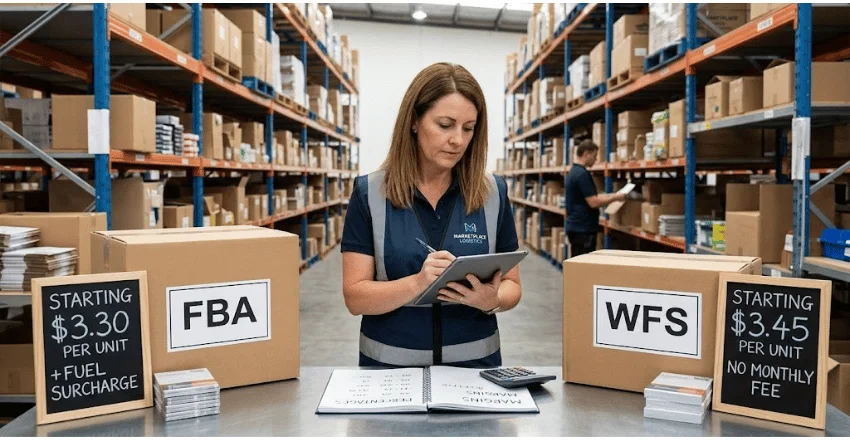
Amazon FBA starts near $3.30 per unit for small standard items and around $4.98 for large standard. Fees rose by roughly $0.08 per unit on average in January 2026. A 3.5% fuel surcharge was added on top in April 2026, and a Professional selling account costs $39.99 a month. Referral fees typically fall between 15% and 18%.
Walmart WFS starts near $3.45 per unit in its lightest weight tier, charges no monthly seller fee, and applies no fuel surcharge. Referral fees run about 12% to 15%. On a one-pound item priced at $20, WFS often lands 8% to 15% cheaper per unit than FBA.
The referral spread matters more than the handling fee. Three points of referral on a $20 order is 60 cents, which is most of a pick fee. Volume still lives on Amazon, so plenty of brands run both and let each channel carry its own stock.
The fees nobody quotes you
Headline rates are the honest part of a quote. Everything below fills out the rest of the invoice:
- Account management, $150 to $450 a month.
- Warehouse software access, $100 to $500 a month.
- Oversize or fragile handling, $1.00 to $3.00 per order.
- Channel-specific surcharges for marketplaces like TikTok Shop: $0.50 to $1.00.
- Aging inventory surcharges that trigger at 180 and 240 days.
Together, these typically add 6% to 9% on top of the rate card. Ask for the aging breakpoint to move to 270 or 365 days before you sign, since slow SKUs are exactly where that surcharge bites.
How to choose, and what to ask

Start from your own numbers, not a provider’s brochure. Pull three months of orders and calculate average items per order, average weight, and your real return rate by category. Those three figures decide which model wins, because pick fees scale with picks and carrier fees scale with weight and distance.
Then ask any candidate five questions. What is the first-item and additional-item fee? What is the monthly minimum? Do you mark up carrier rates, and by how much? Where are your warehouses relative to my buyers? What happens in November when volume triples?
Whatever you choose, the promise on your product page has to match what the warehouse can deliver. A checkout that says “ships today” while your partner cuts off at noon creates a support ticket every time. Treat the delivery message as part of your storefront UI and UX design principles, not a shipping detail.
Next step: open last month’s shipping invoices, add every line to your postage total, and divide by orders shipped. If that figure surprises you, you have found your cheapest margin win this quarter.
Frequently asked questions
Six, in order: receiving inbound stock, storing and counting it, processing the order, picking and packing, handing off to a carrier, and processing any return. Each step carries its own fee, whether you pay it in cash or in your own hours.
Roughly $9 to $16 all in for a standard one-item US parcel in 2026. Multi-item baskets push higher, since a six item order runs about $5.03 in picking alone at midpoint rates.
Above about 300 to 500 orders a month, usually yes, mostly because 3PLs pool carrier volume and get rates you cannot. Below that, monthly minimums and setup fees make in-house packing the cheaper option.
Around 20% across US online retail. Electronics sit closer to 8% to 10%, beauty between 4% and 10%, and apparel anywhere from 25% to 40% depending on how strict your policy is.
Yes, and many brands do. Marketplace stock stays in the platform’s network to keep the fast-shipping badge. Your own site orders ship from a 3PL that can brand the box and handle subscriptions.