

Prorated rent is a partial-month rent charge based on the number of days for which a tenant is responsible for a unit. A common formula divides the monthly rent by the number of calendar days in that month. You then multiply the daily rate by the number of billable days. Some agreements use a 30-day or annual method instead, so check the lease first.
This calculation commonly applies when someone moves in after the first day of the month or leaves before the end of a billing period. It can also apply when a lease begins, ends, or renews between normal payment dates.
| Prorated Rent | What to know |
| Purpose | Charges rent only for the applicable part of a billing period |
| Common formula | Monthly rent ÷ days in the month × billable days |
| Other methods | Fixed 30-day method or annual daily-rate method |
| Common situations | Mid-month move-in, move-out, or lease-date change |
| Most important check | Read the lease and applicable local rules. |
| Rounding | Keep full precision until calculating the final amount. |
Key takeaways
- The calendar-day formula is simple, but it isn’t the only calculation method.
- The lease should identify which method applies whenever possible.
- Count billable days carefully, including the first day if the agreement treats it as chargeable.
- Different formulas can produce different totals from the same monthly rent.
- Deposits and other fees should be treated separately unless the agreement says otherwise.
How Prorated Rent Is Calculated

The most common method starts with the full monthly rent. Divide that amount by the number of calendar days in the applicable month. Then multiply the result by the number of billable days.
The formula is
Partial-month rent = monthly rent ÷ days in the month × billable days
Suppose a lease starts on August 20 and the monthly rent is $1,800. If August 20 counts as a billable day, there are 12 billable days through August 31.
The calculation becomes
- $1,800 ÷ 31 = $58.0645 per day
- $58.0645 × 12 = $696.77
- Final partial-month rent: $696.77
Keeping several decimal places during the calculation and rounding only the final amount can reduce small rounding differences.
Why Different Calculation Methods Give Different Answers
Not every property owner or manager uses the actual number of calendar days in a month. Three common approaches are the calendar-day method, a standard 30-day method, and an annual daily-rate method.
Here is what happens with the same $1,800 monthly rent and 12 billable days:
| Method | Daily-rate calculation | Amount for 12 days |
| Actual 31-day month | $1,800 ÷ 31 | $696.77 |
| Standard 30-day month | $1,800 ÷ 30 | $720.00 |
| Annual method | $21,600 ÷ 365 | $710.14 |
That difference matters. Two people can perform the arithmetic correctly yet reach different totals because they used different calculation methods. For this reason, the calculation method should be identified before determining the final payment.
How to Count Billable Days Correctly
Counting the days incorrectly is one of the easiest ways to make a mistake. The first question is whether the move-in date itself counts as a billable day.
For example, a tenant who takes possession on August 20 and remains through August 31 may have 12 billable days if responsibility begins on August 20.
Always confirm three dates before calculating:
- The date responsibility for the unit begins.
- The final billable date in that billing period.
- The next regular payment date.
A billing period can also span parts of two different months. In that case, each month may have a different daily rate under the calendar-day method.
When Is a Partial Month Charge Commonly Used?
Mid-month move-ins are the clearest example. A tenant may receive the keys on the 10th, 15th, or 20th instead of the first day of the month. Move-outs can create the same issue. If responsibility for the unit ends before the final day of a normal billing cycle, the parties may need to calculate a partial amount. Whether that adjustment applies can depend on the lease and local requirements.
Other possible situations include:
- a lease renewal with an unusual effective date;
- an approved extension after the original end date;
- a billing date that doesn’t fall on the first day of the month;
- an agreed early termination; and
- a transition between two established billing dates.
Property owners comparing long-term housing income can also review Litycoop’s rental property guide for broader factors that can affect rental investments.
Should Deposits and Other Charges Be Prorated Too?
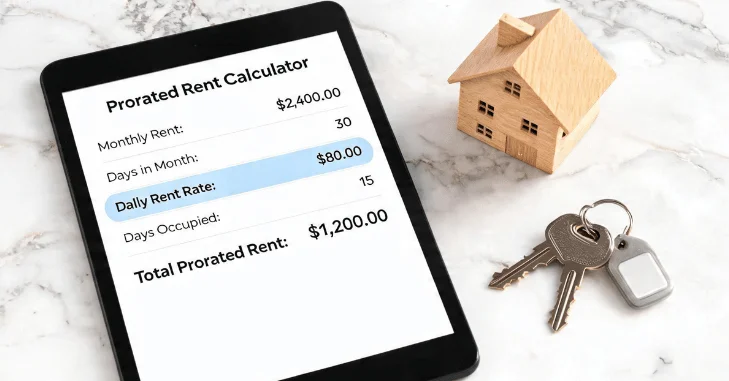
A partial rent payment doesn’t automatically mean every move-in cost should be calculated using the same formula.
A security deposit, parking charge, utility charge, pet fee, or other expense may follow separate terms.
Check each item listed in the lease or move-in statement. Don’t assume that a one-time fee should be divided by the number of occupied days.
Keeping the charges separate also makes the statement easier to understand:
- monthly rent;
- partial-month rent;
- security deposit;
- recurring add-ons; and
- one-time fees.
For related housing topics, Litycoop’s Real Estate section collects property-focused articles in one place.
What Renters Should Check Before Paying
Start with the lease. Look for language covering the start date, payment date, daily-rate formula, early move-out rules, and partial-month billing.
Then reproduce the calculation yourself. Ask for a written breakdown if the invoice provides only a final amount.
Check these details:
- Is the correct monthly rent being used?
- Which calculation method applies?
- How many days are being billed?
- Does the first day of possession count?
- Were any unrelated fees added?
- Was the final amount rounded only after the full calculation?
If the total still looks incorrect, ask the property manager to explain the formula in writing. A transparent calculation is much easier to review than a single unexplained charge.
What Landlords and Property Managers Should Do
Choose a calculation method before a partial billing situation occurs. Put the method in the lease or written policy and apply the same process consistently in comparable situations.
A clear written policy should state:
- which daily-rate method is used
- whether the first and last days of occupancy count;
- when partial billing applies;
- how calculations that cross two months are handled; and
- when the final amount is rounded.
Rental terms must also comply with applicable housing laws and regulations. Because state and local requirements can differ, landlords and property managers should check the rules that apply where the property is located.
Common Calculation Mistakes to Avoid

The first mistake is dividing every monthly rent amount by 30 without checking which calculation method applies. Doing so can change the result in a 28-, 29-, or 31-day month. The second mistake is counting the dates incorrectly. A one-day error can change the invoice by a full day’s rent.
Another mistake is rounding the daily amount too early. Keep additional decimal places during the calculation, then round the final payment to the nearest cent. Finally, don’t combine partial-month rent with deposits or unrelated fees and treat everything as one amount. Itemized billing makes errors easier to identify.
Conclusion
Prorated rent provides a practical way to calculate a partial-month payment when a tenant’s responsibility for a rental property begins or ends during a normal billing period. The correct amount depends on the agreed calculation method, the applicable dates, and the terms of the lease. Before paying or billing prorated rent, confirm the monthly rent, daily-rate formula, billable days, rounding method, and any separate deposits or fees. Because rental laws and lease requirements can vary by location, tenants and landlords should review the agreement and applicable local rules whenever the calculation or billing obligation is unclear.
Check the Formula Before You Sign or Pay
A partial-month charge should be easy to reproduce on paper. Confirm the monthly rent, the agreed daily-rate method, the billable dates, and the rounding rule. If you’re a tenant, ask for the calculation before paying an unclear invoice. If you manage property, put the calculation method in writing before a billing issue arises. Clear calculations and clear lease terms can prevent a small billing question from turning into a larger dispute.
Frequently Asked Questions
Not in every situation. The answer can depend on the lease and the laws that apply where the property is located. Check the agreement and applicable local rules before assuming that a partial-month calculation is required.
Both methods are used. Some agreements divide the monthly rent by the actual 28, 29, 30, or 31 calendar days in the month. Others use a fixed 30-day standard. The lease or written policy should identify the applicable method.
Yes. Under this approach, multiply the monthly rent by 12 and divide the result by 365 to calculate a daily rate. In a leap year, the calculation may use 366 days instead.
It can. If the tenant’s responsibility for the unit begins on the move-in date, that date may count as a billable day. Check the lease and the agreed possession date rather than assuming that the first day is excluded.
Yes. If a billing period crosses two calendar months, the calendar-day method may require a separate daily rate for each month. Calculate the applicable amount for each month and then add the two figures together.