
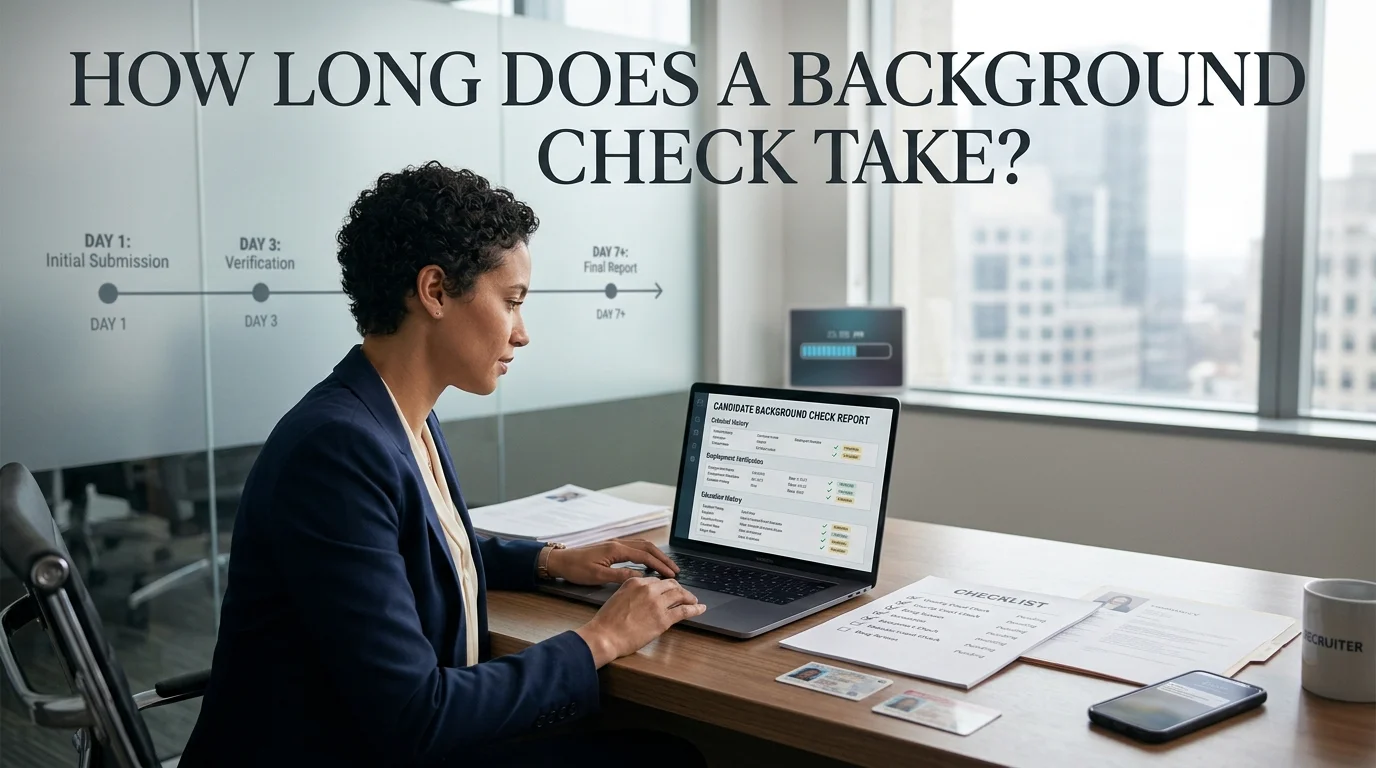
If you’re waiting after an interview or conditional job offer, asking how long does a background check take is understandable. For many standard pre-employment screenings, two to five business days is a reasonable estimate. Some reports finish faster, while manual record searches and verification requests can extend the timeline.
Short answer: Most routine employment screenings are completed within a few business days. A simple criminal records search may return within hours or one to three days. Employment, education, and reference checks can take longer because another organization may need to respond. A delay does not necessarily mean the report found a problem.
| Screening component | Typical timing | What can slow it down |
| Standard employment screening | 2–5 business days | Multiple checks performed together |
| Criminal records | About 1–3 days | Manual court searches |
| Employment verification | Minutes to 2–7 days | Former employer response times |
| Education or credentials | Often 3–5 business days | School or credential issuer response |
| Reference checks | 2–5 days | Reference availability |
| Driving record | About an hour to 1–3 business days | State or source access |
Actual timing varies depending on the employer, screening company, location, and type of information being verified.
Key Takeaways
- A routine employment screening often finishes within two to five business days.
- Automated searches can be much faster than checks that require phone calls or manual court research.
- Employment, education, international, and reference verification can extend the waiting period.
- A slow result does not automatically mean negative information was found.
- Providing accurate information and responding quickly to document requests can help prevent avoidable delays.
How Long Does a Background Check Take for Employment?
There is no single turnaround time for every applicant. Employers choose different screening packages based on the position, industry, location, and information they need to verify.
Many standard pre-employment checks are completed within two to five business days. That range should be treated as an estimate rather than a guaranteed deadline. A screening package that includes only fast database searches may finish sooner. One that involves several employers, schools, courts, or jurisdictions may take longer.
Why Different Screening Types Have Different Timelines
A criminal records search can move quickly when records are available electronically. When a court requires a manual search, the process may take several additional days. Employment verification is less predictable. Automated employment records may be returned quickly, but manual confirmation depends on someone at a former employer responding to the request.
Education and credential checks face a similar challenge. A school, university, licensing body, or other institution may need to confirm the information before the screening can be completed.
International hiring may add another layer of complexity. Different record systems, local procedures, languages, and source availability can all affect turnaround times. Businesses hiring employees across borders can also review LityCoop’s resources on remote employment and international workforce management.
5 Common Reasons a Background Check Takes Longer
A longer wait is often caused by routine administrative or verification issues. These five factors commonly affect screening timelines.
- A court requires manual research. Not every county or jurisdiction provides all records through an instant electronic search. Manual retrieval usually takes longer.
- A former employer is slow to respond. Manual employment verification depends on another organization answering the screening request.
- Candidate information needs clarification. Missing or inconsistent names, dates, addresses, or employment details may require additional verification.
- Several jurisdictions must be searched. People who have lived, studied, or worked in multiple locations may require additional record searches. International checks can also take longer.
- A source operates during normal business hours. Courts, schools, employers, and references may require human responses, so weekends and holidays can extend the timeline.
None of these delays proves that the screening uncovered negative information. Timing alone tells you very little about the final result.
What You Can Do While You Wait
Start by checking the candidate portal and the email address you used when applying. A screening company may request clarification or supporting documents. Respond promptly if you receive a legitimate request. Make sure your name, previous addresses, employment dates, education details, and other submitted information are accurate.
If the expected completion date has passed, contact your recruiter or hiring manager for an update. They may be able to confirm whether the report is still being processed or awaiting information from a particular source. Use an official screening portal or verified contact when sharing sensitive personal information. Avoid sending identification documents to an unfamiliar email address without confirming who will receive them.
Does a Longer Background Check Mean Something Is Wrong?

Not necessarily. A background check may take longer because records are difficult to access, a former employer has not responded, or a court must conduct a manual search. Delays can also occur when an employer requests several types of verification.
The length of the process is not a reliable indication of whether the report contains positive or negative information. If you are concerned, contact the recruiter or employer after the expected processing period has passed. A simple status request is usually more useful than trying to interpret the delay.
What If the Report Contains Incorrect Information?
Applicants may have legal protections when employers use third-party consumer reporting companies to make employment decisions. In the United States, employers generally must provide appropriate disclosure and obtain permission before requesting certain employment background reports. Additional requirements may apply if information in the report could lead to an adverse employment decision.
If you believe a report contains inaccurate or incomplete information, you may be able to dispute it with the company that prepared the report. Because employment screening laws can vary by jurisdiction, employers should review the rules that apply to their location and circumstances.
LityCoop readers can also review the site’s guide to employment laws for business owners for broader workplace and compliance topics.
How Employers Can Reduce Background Check Delays
Employers can also take steps to make the screening process easier for candidates. First, clearly explain what information applicants need to provide. Missing dates, incorrect names, and incomplete employment histories can cause unnecessary verification problems.
Second, tell candidates what timeline they should expect. Giving applicants a realistic estimate can reduce confusion and unnecessary follow-up messages. Third, communicate when additional information is required. Prompt communication helps candidates resolve issues before they cause longer delays. Companies should also use screening procedures that are appropriate for the role and consistent with applicable employment laws.
What to Do Next
Most applicants do not need to worry during the first few business days. Monitor your email and candidate portal, keep requested documents available, and follow up if the estimated turnaround time has passed.
Employers moving from screening to onboarding may also find LityCoop’s article on payroll services for small businesses useful. A background check is only one part of the hiring process. Clear communication, accurate information, and realistic expectations can make the waiting period easier for both employers and candidates.
Frequently Asked Questions
Many routine pre-employment screenings take about two to five business days. More complex checks can take longer, especially when courts, schools, former employers, or international sources must respond manually.
Common reasons include manual court research, slow responses from employers or schools, incomplete information, and searches across several jurisdictions. International records may also require additional processing time.
Some automated searches may continue outside normal business hours. Other steps depend on courts, schools, employers, references, or human reviewers. For that reason, screening timelines are often measured in business days.
You cannot control the response times of the court, school, or employer. You can reduce avoidable delays by submitting accurate information, monitoring your email and the candidate portal, and responding promptly when additional information is requested.
You cannot control the response times of the court, school, or employer. You can reduce avoidable delays by submitting accurate information, monitoring your email and the candidate portal, and responding promptly when additional information is requested.
Yes. More complex screenings may take longer than a week, especially when they involve manual record searches, international verification, multiple previous employers, education checks, or several jurisdictions.