

Going to court can cost time and money, so the first question isn’t how to file. It’s whether your dispute gives you a legal claim, whether you’re within the deadline, and whether the person or business you plan to name can provide the remedy you want.
Short answer: To sue someone in the United States, you generally need a valid civil claim, the correct court, a filing made before the deadline, and proper service on the defendant. You should also organize your evidence and document your damages. The case may then move through a response, discovery, settlement, trial, judgment, and collection.
| Pre-filing question | What to check | Why it matters |
|---|---|---|
| Do you have a legal claim? | Facts, legal duty, breach or wrongful conduct, and harm | A personal disagreement alone may not create a civil claim |
| Are you within the deadline? | The statute of limitations and any notice requirements | Filing late can prevent the court from hearing the case |
| Which court should hear it? | Location, claim type, amount, and available remedies | Filing in the wrong court can cause delays or dismissal |
| Can you prove what happened? | Contracts, messages, photos, receipts, records, and witnesses | The court decides cases based on admissible evidence |
| Who is the correct defendant? | The legal name of the person or business | Naming the wrong party can create serious problems |
| What result do you want? | Money, the return of property, or another available remedy | Courts can grant only remedies allowed by law |
| Could you collect a judgment? | Income, assets, insurance, or another payment source | Winning and collecting are separate stages |
Before Filing, Test Whether a Lawsuit Is the Right Tool
A civil case requires more than anger, unfair treatment, or a broken promise. You generally need a recognized legal claim and facts that support each required element. You also need to identify the harm and the remedy you’re asking the court to provide. Deadlines deserve early attention. Statutes of limitations vary by state and claim type. Some disputes also have notice requirements or contractual procedures that must be completed before filing.
California’s court self-help guidance, for example, tells prospective plaintiffs to check deadlines, evidence, court location, and any required mediation or arbitration before starting a case. Your claim may also fit within a specialized court or procedure. Small claims courts often offer a simpler route for eligible disputes, but dollar limits and rules differ by state. Do not assume that a rule from another state applies where you live.
For related reading, Litycoop maintains a law section covering civil procedure and consumer disputes in plain language. Those pages provide related background, not substitutes for current local court rules.
What You Will Need Before Filing
Build a case file before preparing court papers. It should contain the defendant’s correct legal name and address, a dated timeline, supporting documents, witness information, and a clear calculation of your losses. You should also know what outcome you want. If money would resolve the dispute, write down the amount and explain how you calculated it. If you want another remedy, check whether the court you’re considering has the authority to grant it.
A demand letter may also make sense before filing. It can state what happened, what you want, and a reasonable deadline for a response. Some disputes settle before a complaint reaches the courthouse.
How to Sue Someone in 7 Steps
- Identify your legal claim. Write down what happened, what legal duty you believe was violated, and what loss followed. Separate provable facts from assumptions. If you can’t explain the claim clearly, consider getting legal advice before spending money on filing.
- Check every deadline. Find the statute of limitations for your claim and state. Also check for shorter notice periods, administrative claims, arbitration clauses, or other pre-filing requirements. A missed deadline can be more damaging than a weak argument.
- Choose the correct court and defendant. Confirm the defendant’s legal identity and the case’s jurisdiction. Court selection may depend on geography, the amount sought, and the type of claim. Small claims court may be suitable for some lower-value disputes.
- Organize your evidence and damages. Put contracts, invoices, texts, emails, photos, medical records, repair estimates, and other relevant records in chronological order. Create a damages calculation showing how you arrived at the requested amount.
- File the required complaint. A civil action generally begins with a complaint that states the claim and the requested relief. Federal civil cases begin this way under Rule 3 of the Federal Rules of Civil Procedure, while state courts use their own forms and procedures. Filing fees or fee-waiver procedures may apply.
- Serve the defendant correctly. Filing the case doesn’t automatically notify the other side. Court rules require formal service using approved methods. Federal Rule 4 governs service in federal civil cases, while state procedures can differ. Follow the rules for your court closely.
- Prepare for the case after service. The defendant may answer, raise defenses, or file motions. The parties may exchange information through discovery. Settlement can happen before trial. If no agreement is reached, the court may decide the dispute at trial.
How Much Does a Civil Lawsuit Cost?
There is no reliable nationwide price for bringing a civil claim. Costs depend on the court, jurisdiction, complexity, service requirements, evidence, and whether you hire an attorney. Possible expenses include filing fees, service costs, document fees, expert costs, deposition expenses, and attorney fees. Some courts offer fee waivers for people who qualify.
The federal judiciary’s overview of civil cases on uscourts.gov explains that eligible parties may request permission to proceed without prepaying certain fees. Before filing, compare the likely cost with the amount you could realistically recover. A legally valid case can still make little financial sense if litigation costs exceed the practical value of the dispute.
Costs also depend on the underlying subject matter. A workplace dispute, for instance, can involve separate employment rules, which Litycoop covers in its employment-law overview for business owners.
Can You File a Case Without a Lawyer?
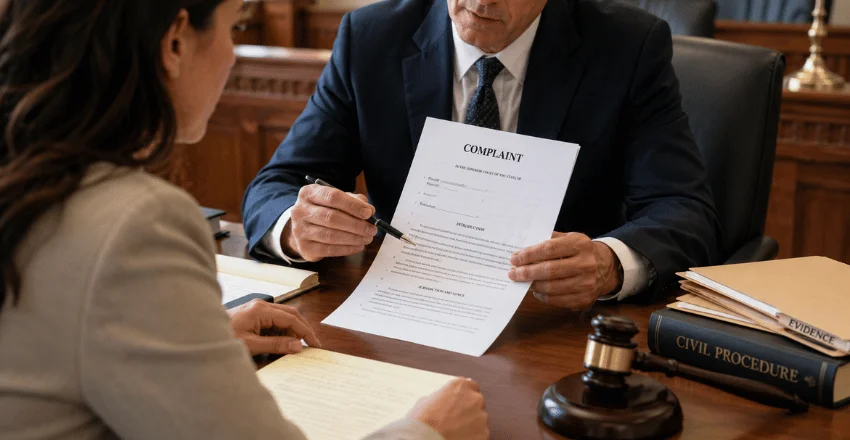
Individuals can represent themselves in many civil proceedings. Whether that is sensible depends on the claim. A straightforward small claims dispute may be easier to handle without counsel. A case involving serious injury, substantial damages, multiple defendants, technical evidence, a business entity, or an unusual deadline may warrant professional assistance.
If attorney fees are a concern, start with legal aid and lawyer referral resources. USA.gov directs people to free and low-cost civil legal services, including those provided by organizations supported by the Legal Services Corporation. Injury claims are a common example of a dispute where the evidence gets technical quickly, as Litycoop’s article on motorcycle injury claims illustrates.
What Happens After You File?
Filing is the start, not the finish. After valid service, the defendant normally has a deadline to respond. Motions may follow, and the parties can exchange relevant information through discovery. Many cases are resolved through negotiation or settlement instead of trial. If the dispute continues, each side presents evidence under the court’s rules, and a judge or jury may enter a judgment.
A favorable judgment also doesn’t guarantee immediate payment. If the losing party doesn’t pay voluntarily, the winning party may need to use lawful collection procedures available in that jurisdiction. California’s civil-court guidance, for example, treats payment and collection as a separate stage after trial.
Your Next Step
Before paying a filing fee, check three things against an official source: your deadline, your court, and your service rules. Use your state judiciary’s website or the court clerk’s official instructions rather than relying on rules from another jurisdiction. If the claim involves substantial money, serious injury, complicated evidence, or an approaching deadline, consider speaking with a licensed attorney. A short review before filing can identify problems that are harder to correct later.
Frequently Asked Questions
You generally need a legally recognized claim, the proper defendant, a court with the authority to hear the dispute, timely filing, and evidence supporting your allegations. The exact requirements depend on state law and the type of case.
There is no single U.S. deadline. Statutes of limitations vary by jurisdiction and claim. Certain claims also require advance notice or another step before filing. Check the applicable rule as soon as a dispute arises.
No. Small claims court can be simpler, but each state sets its own limits, procedures, and available remedies. Your dispute must qualify for that court.
No, but legal help becomes more valuable as the case grows in value or complexity. An attorney can also help identify deadlines, defendants, defenses, and procedural problems before they become expensive.
You may need to enforce the judgment through collection procedures allowed by your state. Winning establishes the obligation, but it doesn’t automatically place the money in your account.