
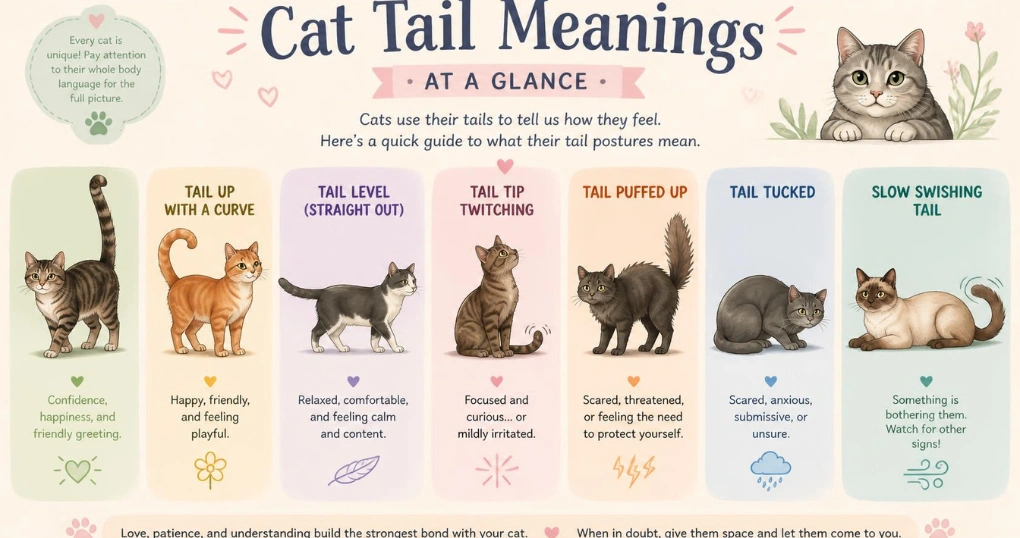
Your cat may not use words, but their tail can give you useful clues about how they feel. Understanding cat tail meanings can help you recognize friendly greetings, playful focus, fear, irritation, and possible discomfort before you approach or continue an interaction. The key is to read the tail together with the ears, eyes, posture, and situation rather than treating one position as a fixed translation.
Quick answer: Cat tail signals depend on position, movement, and context. A high tail often suggests confidence or a friendly greeting, while a puffed or tucked tail can point to fear or stress. Fast thrashing usually means a cat wants space, while a gently curved tip commonly appears during relaxed social interaction.
| Tail signal | What it often indicates | Helpful response |
| Straight up | Confidence, friendliness | Offer calm attention. |
| Upright with curved tip | Friendly, playful interest | Invite gentle interaction. |
| Puffed up | Fear, alarm, feeling threatened | Give the cat space. |
| Low or tucked | Anxiety, fear, possible pain | Reduce pressure and observe. |
| Wrapped around you | Friendly social contact | Respond gently. |
| Wrapped around the body | Resting, self-protection, possible discomfort | Check the full body posture. |
| Slow side-to-side swish | Focus or predatory interest | Let the cat concentrate. |
| Fast flicking or thrashing | Irritation or overstimulation | Pause touching |
| Twitching tip | Focus, play, or mild annoyance | Check what has the cat’s attention. |
| Upright quiver | Excitement or possible urine marking | Read the surrounding behavior. |
TL;DR
- A raised, relaxed tail commonly signals a confident and social cat.
- A puffed tail usually means the cat feels threatened or startled.
- Tucking the tail can indicate fear, anxiety, or sometimes discomfort.
- Slow movement may show intense focus, while sharp thrashing often signals irritation.
- A quivering upright tail can accompany an excited greeting, but context matters.
- Sudden, persistent changes in posture or movement deserve closer attention.
Cat Tail Meanings at a Glance
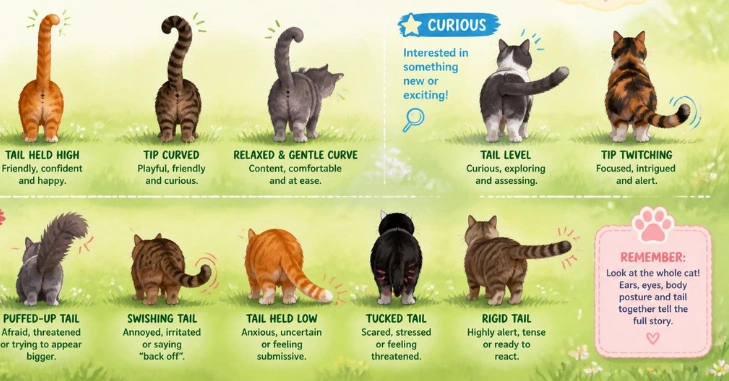
Cat Tail Meanings: Tail posture is useful because cats can change the tail’s height, shape, stiffness, and speed as their emotional state changes. Veterinary behavior resources consistently advise reading those signals alongside the rest of the body, since the same movement can carry different meanings in different situations. A flick during play, for example, does not automatically mean the same thing as a sharp flick that begins while you are petting an otherwise tense cat.
You can find this article and future animal-focused material through the Litycoop Pets section. The category is already live, which gives the site a logical home for related pet guides as they are added. Litycoop also maintains broader lifestyle guides for everyday topics.
10 Tail Positions and Movements and What They May Mean
1. Tail held straight up
A cat walking toward you with the tail upright is commonly feeling confident, comfortable, and open to social contact. You may see this posture when your cat greets you after you enter a room or approaches another familiar cat. If the rest of the body looks loose and relaxed, gentle interaction is usually appropriate.
2. Upright Tail with a Question-Mark Curve
An upright tail with a soft hook at the end is another positive signal in many situations. PetMD describes this position as a friendly approach, while Purina associates the question-mark shape with playful interest. You can offer attention or a toy, then allow the cat to decide whether the interaction continues.
3. Puffed or Bottlebrush Tail
A tail that suddenly looks much larger usually means the fur has risen because the cat feels startled, frightened, or threatened. The cat may also arch the back, turn partly sideways, or stiffen the rest of the body to appear larger. Avoid moving closer, because giving the animal room to settle is usually safer than attempting to comfort it through touch.
4. Tail held low or tucked underneath
A low tail can suggest uncertainty, fear, anxiety, or discomfort, especially when the cat also crouches. A tail tucked tightly under the body deserves more attention than a naturally low but relaxed posture during ordinary movement. If this behavior appears suddenly or accompanies other changes in activity, appetite, movement, or social behavior, watch your cat closely.
5. Tail wrapped around you or another cat
Wrapping the tail around a familiar person or another cat can be a friendly social gesture. PetMD describes tail wrapping as affiliative behavior that can communicate willingness to interact, while Purina also links it with affection. Think of it as a positive clue, then confirm the message by looking for relaxed ears, posture, and facial expression.
6. Tail wrapped tightly Around the cat’s body
A resting cat may place the tail around the body simply because that position feels comfortable or helps conserve warmth. A tight wrap paired with crouching, tension, hiding, or reduced interaction can instead suggest fear, defensiveness, pain, or illness. Repeated behavior matters more than one quiet nap, so compare the posture with what is normal for your cat.
7. Slow swishing from side to side
A slow, measured sweep often appears when a cat is intensely focused on something in the environment. You might notice it while your cat watches a bird, studies a toy, or prepares to pounce during play. In that setting, the movement can reflect concentration rather than anger, which is why context changes the interpretation.
8. Fast flicking, lashing, or thrashing
Fast, forceful movement is a much stronger warning than a slow hunting sway. A cat that begins thumping or thrashing during petting may be irritated, overstimulated, or asking for the contact to stop. Pausing before the cat needs to hiss, swat, or bite helps you respect an early boundary signal.
9. Twitching at the Tip
Small movements at the tip can occur during hunting, play, focused observation, mild frustration, or irritation. A cat watching an insect may twitch for a completely different reason than a cat whose tail starts snapping during unwanted handling. Look at what happened immediately before the movement and whether the rest of the body appears loose or tense.
10. Upright Tail That Quivers or Vibrates
A raised tail that quivers can appear when a cat is excited to greet a person or another familiar animal. A similar vibrating motion can also occur during urine marking, particularly when the cat backs toward a vertical surface. The position of the body, location, and presence of urine help distinguish an enthusiastic greeting from marking behavior.
Read the Whole Cat, Not Only the Tail.
The safest interpretation comes from combining tail movement with the ears, eyes, whiskers, posture, sounds, and immediate environment. Forward ears and a loose body can support a friendly reading, while flattened ears, a tense crouch, hissing, or fixed staring point toward a different emotional state. Even a familiar signal can change meaning when the rest of the body changes.
A simple approach is to use a green, yellow, and red response rule. Green signals include a relaxed body and upright or softly curved tail, yellow signals include increasing flicking or tension, and red signals include hard thrashing, puffing, hiding, or defensive behavior. This response-focused system does not attempt to label every emotion perfectly; it helps you decide whether to engage, slow down, or give your cat space.
When Tail Behavior May Point to Pain or Illness
Tail position is not a medical diagnosis, but an unusual change can sometimes accompany pain or illness. Veterinary sources note that a persistently tucked or tightly wrapped tail, especially with other behavioral changes, can warrant professional evaluation. Changes are more concerning when your cat also hides, moves differently, avoids touch, eats less, vocalizes unusually, or seems unable to move the tail normally.
Contact a veterinarian if a change is sudden, persistent, painful-looking, or follows an injury. A limp tail, visible wound, swelling, or difficulty using the hindquarters deserves prompt attention rather than a body-language interpretation alone. Your veterinarian can separate a behavioral signal from a physical problem that needs treatment.
Use Tail Signals to Make Better Choices Around Your Cat
Learning these patterns is less about assigning a rigid emotion to every twitch and more about noticing when your cat welcomes contact or needs space. Paying attention to changes in speed, height, stiffness, and surrounding body language can make everyday interactions calmer and easier to understand. Over time, your own cat’s repeated patterns will become more useful than any single chart.
For more practical animal and everyday-life explainers, browse the Litycoop home page and its dedicated pet category. If a new tail posture appears alongside pain, injury, reduced activity, or another health change, contact your veterinarian instead of relying on behavioral interpretation. That distinction keeps body-language reading useful without asking it to do the job of a medical examination.
Conclusion
Understanding cat tail meanings can give cat owners a valuable window into feline communication, but the tail should never be read in isolation. A relaxed upright tail may signal confidence and friendliness, while a softly curved tip can accompany playful or social behavior. In contrast, a puffed, tucked, or rapidly thrashing tail may indicate fear, stress, irritation, or a desire for more space.
The most important lesson is to look at the whole cat. Ears, eyes, whiskers, body posture, vocalizations, and the surrounding situation can change how a particular tail movement should be interpreted. A slow tail sweep while watching a toy may reflect intense concentration, while fast flicking during petting can be an early warning that your cat has become overstimulated.
Frequently Asked Questions
Why do cats wag their tails while lying down?
A cat lying down may move the tail because something has captured their attention, because they are becoming irritated, or because they are interacting during play. Gentle movement during rest can also occur without indicating a problem. Watch the speed of the motion and the cat’s ears, eyes, muscles, and surroundings before deciding what it means.
What does it mean when a cat flicks its tail while being petted?
Tail flicking that becomes sharper or faster during petting can be an early sign of overstimulation or annoyance. Stop or reduce contact and see whether the tail and body relax before touching the cat again. Responding to the warning can prevent the interaction from escalating into hissing, swatting, or biting.
Why does my cat walk toward me with its tail straight up?
An upright tail commonly accompanies a friendly, confident approach. Researchers and veterinary behavior resources have long associated the raised-tail greeting with positive social interaction among cats and between cats and familiar people. A loose body and relaxed facial expression make the friendly interpretation even stronger.
Are cat tail meanings always reliable?
No single signal should be treated as a guaranteed translation of what a cat feels. Individual temperament, surroundings, health, and the rest of the body can change the meaning of a movement. Use the tail as one piece of evidence and learn the patterns that consistently appear in your own cat.