
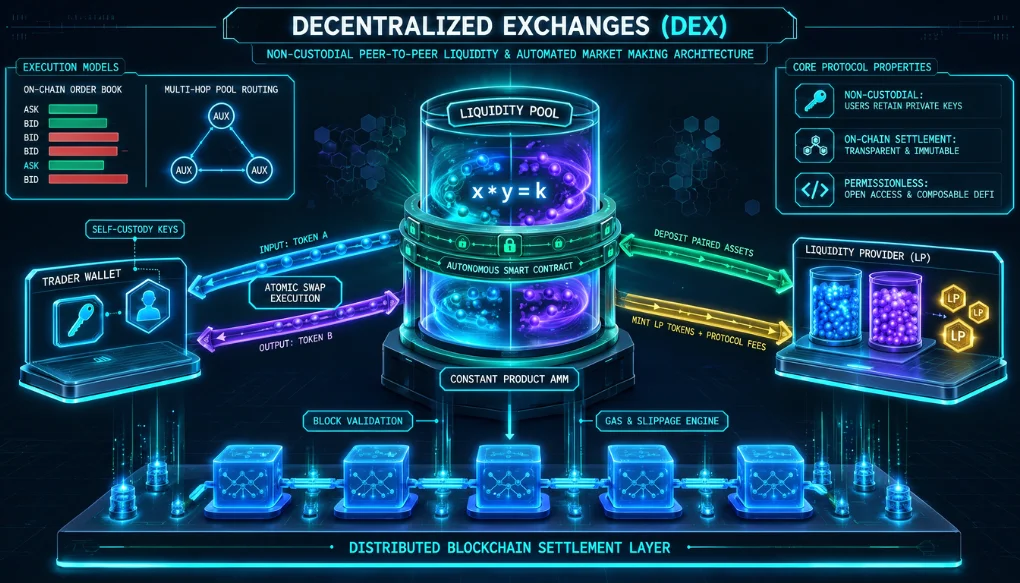
Decentralized exchanges let crypto users trade tokens directly from their wallets through blockchain-based software. They remove the need to deposit assets with a traditional exchange before each trade. For US users, that control comes with extra responsibility for security, taxes, fees, and platform restrictions.
A DEX can make on-chain trading flexible, but it does not make every transaction safe. You still need to check the protocol, token, network, liquidity, and transaction details. Understanding these basics can prevent expensive mistakes before you approve a wallet transaction.
Direct answer: A DEX is a blockchain-based marketplace that lets users swap crypto without giving a centralized company custody. Smart contracts execute trades using liquidity pools, order books, or routing systems. Users keep their private keys, but they also carry greater responsibility for security, transaction costs, and errors.
Decentralized Exchange Facts at a Glance
| Topic | What US Users Should Know |
|---|---|
| Custody | You usually keep control of your wallet and private keys |
| Trade execution | Smart contracts process swaps on a blockchain |
| Common models | AMMs, order-book DEXs, and aggregators |
| Account required | Usually no traditional exchange account |
| Fiat support | Often limited compared with centralized platforms |
| Main costs | Trading fees, network gas, slippage, and price impact |
| Main risks | Smart-contract flaws, fake tokens, wallet mistakes, and poor liquidity |
| US taxes | Crypto-to-crypto exchanges can create taxable gains or losses |
| US access | Availability may depend on the protocol, interface, asset, and location |
Key Takeaways
- A DEX usually lets you keep custody instead of depositing coins with an exchange.
- Automated market makers use token pools instead of matching every buyer with a seller.
- Network fees and slippage can matter as much as the advertised trading fee.
- Self-custody removes some intermediary risk but introduces wallet and transaction risks.
- US traders should keep detailed records because token swaps can have tax consequences.
- Access to particular protocols or products can differ for US residents.
How Decentralized Exchanges Work

Most decentralized exchanges use smart contracts to execute token swaps according to predefined rules. These programs operate on networks such as Ethereum, Solana, Base, or BNB Chain. A connected wallet signs the transaction before the blockchain processes it.
Suppose you want to exchange ETH for USDC through an automated market maker. You connect a compatible wallet and select the amount you want to swap. The protocol calculates a price using available liquidity and displays estimated fees before approval.
You then approve the transaction from your wallet and pay the required network fee. The smart contract completes the exchange if the transaction meets its programmed conditions. The purchased tokens return directly to your wallet rather than an exchange-controlled account.
Blockchain choice can strongly affect that experience because fees and transaction speeds differ across networks. Litycoop has also covered several competing smart-contract networks beyond Ethereum. That background can help readers understand why DEX activity has expanded across multiple chains.
Read Litycoop’s Ethereum competitors overview
The Three Main Types of DEX
Automated Market Makers
Automated market makers, commonly called AMMs, trade against pools containing crypto assets. Users called liquidity providers supply tokens to those pools and may receive part of trading fees. A mathematical pricing mechanism adjusts rates as trades change each pool’s balance.
Uniswap helped popularize this approach, although many other protocols now use similar systems. AMMs allow trading without waiting for another person to place a matching order. Large trades can still produce substantial price impact when liquidity is limited.
Order-Book DEXs
Order-book platforms organize offers to buy and sell assets at specified prices. This structure feels more familiar to people coming from conventional trading platforms. Some newer systems combine on-chain settlement with specialized infrastructure designed for faster execution.
This model is particularly common among platforms offering advanced trading or perpetual contracts. Features and legal availability can differ significantly between spot swaps and leveraged products. US residents should confirm current eligibility before using any trading interface.
DEX Aggregators
Aggregators search several liquidity sources instead of relying on one trading pool. Their goal is usually to find a better execution route for a requested swap. A route may even divide one transaction across several pools.
This can reduce price impact or improve the quoted rate in certain market conditions. It can also make the transaction path more complicated for a new user. Always review the final amount received rather than focusing only on the displayed exchange rate.
DEX vs. Centralized Exchange
A centralized exchange normally creates an account for each customer and controls assets deposited on its platform. A DEX usually leaves those assets inside a wallet controlled by the user. That difference changes security responsibilities, onboarding, support, and transaction execution.
| Feature | DEX | Centralized Exchange |
|---|---|---|
| Asset custody | Usually controlled by the user | Usually controlled by the company |
| Trading mechanism | Smart contracts | Central matching system |
| Wallet needed | Usually yes | Not always |
| Fiat deposits | Often limited | Common |
| Customer support | Often limited | Usually available |
| Token selection | Can be broad | Assets are selected by the platform |
| Transaction reversal | Generally unavailable | Platform may sometimes intervene |
| Learning curve | Higher | Usually lower |
Neither structure removes risk completely. A centralized company can face operational, custody, or insolvency problems. A DEX can expose users to smart-contract bugs, malicious tokens, wallet theft, and irreversible mistakes.
Why Traders Use DEXs
Self-custody is one of the strongest reasons users choose this model. Assets can remain under the owner’s private-key control throughout most trading activity. This reduces dependence on an exchange holding customer funds.
DEXs can also provide access to tokens before centralized platforms decide to list them. That broad selection creates opportunities, but it increases the chance of encountering fraudulent assets. A token appearing in a liquidity pool does not prove its legitimacy.
Transparency offers another advantage because many transactions and smart contracts are visible on public blockchains. Users can examine contract addresses, liquidity, transaction history, and other on-chain information. That transparency still requires enough knowledge to interpret what the data means.
For more financial explainers beyond digital assets, readers can explore Litycoop’s broader finance coverage. The category includes articles about banking, credit, financial services, and related consumer topics. It provides useful background for comparing crypto products with traditional financial services.
Risks You Should Understand Before Trading
Smart-contract risk deserves attention because code can contain vulnerabilities or unintended behavior. Audits can reduce uncertainty, but an audit does not guarantee that a protocol is safe. Users should examine a project’s history, documentation, contract address, and security information.
Token risk is equally important because creating a tradable token can be easy. Scammers may copy names, symbols, websites, or social accounts from legitimate projects. Verify the token’s contract address through reliable project sources before making a swap.
Slippage and price impact can make a trade more expensive than expected. The problem becomes larger when a pool has weak liquidity, or the order is large. Review the minimum amount received and price impact before signing anything.
Wallet security is another major responsibility in self-custody. A fraudulent signature can sometimes grant permissions that expose tokens to theft. Never approve a transaction simply because a website presents a familiar logo.
A Four-Check DEX Filter Before You Swap
Use a simple four-check process before confirming an unfamiliar transaction. This does not eliminate risk, but it forces several important decisions before money moves. The habit is especially useful when exploring smaller tokens or new protocols.
- Verify the website and contract. Confirm the domain and token address through trusted official sources.
- Check liquidity. Thin pools can produce large price changes and poor execution.
- Review the wallet request. Confirm the asset, amount, network, permissions, and expected output.
- Calculate the real cost. Include network fees, trading fees, slippage, and potential tax effects.
This framework is more useful than choosing a platform only because its advertised fee looks low. A cheaper quoted fee can disappear after network costs or poor execution. A safe decision should consider the full transaction rather than one number.
What US Users Need to Know About Taxes and Regulation
US federal tax rules treat digital assets as property rather than currency. Exchanging one digital asset for another can create a reportable gain or loss. The IRS says digital assets are treated as property, and Form 1040 asks every filer a Yes or No question about whether they sold, exchanged, or otherwise disposed of one during the year.
That obligation does not disappear because a trade happened through self-custody software. Users should preserve transaction dates, values, fees, wallet addresses, and acquisition-cost information. Accurate records make later tax calculations much easier.
US regulation of digital-asset trading continues to develop, and different activities can fall under different rules. The SEC has also continued to issue guidance affecting distributed-ledger trading. Such developments do not make every DEX product universally available or automatically compliant.
Protocol access can also differ from access through a particular website or application. An interface may restrict US users even when blockchain contracts remain technically accessible. Check current terms and legal eligibility instead of assuming that wallet connectivity equals permission to trade.
How to Choose a DEX More Safely
Start with the blockchain and assets you intend to use rather than selecting a platform by popularity. Confirm that the protocol supports your network and has enough liquidity for your planned trade. Then compare total transaction costs and security history.
Next, examine whether the platform has clear documentation and an established operating history. Look for independent security reviews and transparent information about its contracts. Be cautious when promotional rewards appear more important than explaining the underlying product.
Beginners may benefit from learning basic blockchain and wallet concepts before moving meaningful funds. Litycoop’s technology section provides additional coverage of digital tools and technology topics. Building technical confidence can make wallet interactions easier to evaluate.
Browse Litycoop’s Tech section
A small test transaction can also reduce the consequences of an address or network mistake. Check the result before moving a larger amount through the same route. Never use money you cannot afford to lose in speculative crypto trading.
The Bottom Line
A DEX gives crypto users greater control over custody and access to on-chain markets. That freedom also transfers many responsibilities from a company to the individual user. Security checks, transaction review, recordkeeping, and careful asset research become essential habits.
For US users, taxes and platform eligibility deserve the same attention as fees or token prices. Check current rules and service terms before committing funds. Treat self-custody as a responsibility rather than an automatic guarantee of safety.
Frequently Asked Questions
What is a DEX in simple terms?
A DEX is software that lets people exchange crypto using blockchain transactions and smart contracts. Users normally connect their own wallets rather than opening a custodial trading account. The wallet owner remains responsible for transaction approvals and private-key security.
Are decentralized exchanges legal in the United States?
There is no single answer covering every protocol, asset, product, or user situation. US securities, commodities, tax, sanctions, and state rules can affect different activities. A platform can also restrict US access through its interface regardless of wider protocol availability.
Do I need to pay taxes when swapping crypto on a DEX?
A crypto-to-crypto exchange can trigger a taxable gain or loss under US federal tax rules. The IRS treats digital assets as property and requires reporting for many dispositions. Keep transaction records even when no centralized broker provides a statement.
Are DEXs safer than centralized exchanges?
They remove some custody risk because users generally keep control of their assets. They introduce different risks involving smart contracts, wallet approvals, scams, liquidity, and irreversible transactions. Safety depends heavily on the protocol and the user’s security practices.
Can beginners use a DEX?
Beginners can use one, but they should understand wallets, networks, gas fees, and token addresses first. Starting with a small amount can reduce the cost of an early mistake. Users should also learn how to identify suspicious approvals and fake websites.